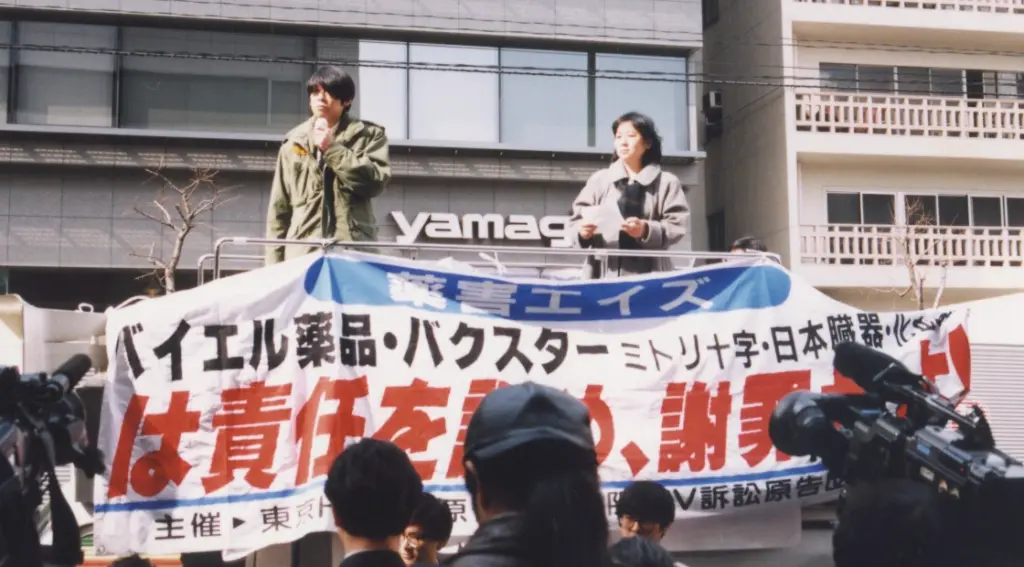
In the 1980s, many people—mainly those with hemophilia, a congenital deficiency of blood coagulation factors—were infected with HIV through the use of non-heat-treated blood products. As these products were not heat-processed to inactivate viruses, HIV entered the blood supply. Even after safer, heat-treated blood products were approved, Japan continued to use non-heated ones, and approximately 1,400 people with hemophilia were infected. Victims filed lawsuits against the government and pharmaceutical companies in 1989, reaching a settlement in 1996.
| 1970s | Approval of non-heat treated blood products (late 1970s) |
| 1980s | Health damage occurrence (mainly around 1982–1985) |
| 1983・1984 | Approval of heat-treated blood products in the US |
| 1985 | Japan’s first HIV-positive case identified Approval for use of heat-treated formulation in Japan |
| 1988 | The House of Representatives Social and Labor Affairs Committee passes the “early relief for patients infected with HIV-contaminated blood products” |
| 1989 | Plaintiffs and legal teams in Tokyo/Osaka HIV lawsuits file lawsuits |
Read More
1. The rise of unheated blood products and HIV infection
Hemophilia is a congenital disorder characterized by the absence or deficiency of certain coagulation factors, making it difficult to stop bleeding. Before blood products became available, hemophilia was considered life-threatening; even minor bleeding could cause “hellish pain,” and transfusions were necessary after every bleeding episode. In the 1970s, non-heat-treated concentrated blood coagulation factor preparations—commonly called non-heated products—were introduced, dramatically improving patients’ quality of life. Patients could now administer the factor concentrates themselves at home, without visiting hospitals. However, these products were made from blood purchased overseas, much of it collected through paid donation systems in the United States. By the early 1980s, HIV—the virus that causes AIDS (Acquired Immunodeficiency Syndrome)—had already spread among such donor populations. As Japanese manufacturers failed to apply heat treatment to inactivate viruses during production, many people with hemophilia who used these products became infected with HIV. In 1985, heat-treated products were finally approved in Japan, originally developed to prevent hepatitis transmission. However, the continued use of non-heated products led to rising numbers of HIV infections. According to a 1996 Ministry of Health and Welfare report, among approximately 4,000–5,000 Japanese people with hemophilia, 1,771 were infected with HIV, and 418 had developed AIDS.
2. The struggle of people with hemophilia
In the 1980s, AIDS was regarded as a “fatal disease.” In 1987, sensational media coverage of female HIV patients triggered a social panic concerning AIDS in Japan. Because of deep social prejudice and misinformation, people with hemophilia faced discrimination at schools and workplaces, and many were not even properly informed of their infection status. With no effective treatment available, many died helplessly after developing AIDS. Amid this situation, in 1988, the House of Representatives’ Committee on Social and Labor Affairs passed a resolution calling for “early relief for patients infected with HIV-contaminated blood products,” and in December of the same year, the AIDS Prevention Law was enacted. However, victims sought compensation rather than limited relief, and in 1989, two infected individuals—Noriyasu Akase and Yoshiaki Ishida—filed lawsuit against the government and pharmaceutical companies. The case expanded into large-scale collective litigation by hemophiliacs nationwide. As stigma surrounding HIV/AIDS remained strong, many plaintiffs participated anonymously. Most of the infected were children and young adults. Young supporters, including students and activists, joined their struggle, organizing demonstrations in front of the Ministry of Health and Welfare (MHW). The issue grew into a major social movement symbolizing the fight for medical justice and human rights. In 1995, the court proposed a settlement, and in 1996, it was finalized, officially recognizing the responsibility of both the state and the pharmaceutical companies. The then Minister of Health issued a public apology to plaintiffs and supporters. Criminal prosecutions followed: three successive company presidents were convicted for prioritizing business profit over human life, and government officials were found guilty for failing to take necessary administrative action. The head of the AIDS Research Committee, who had decided to continue using non-heat-treated products, was also indicted—found not guilty in the first trial, with a subsequent appeal dismissed after his death.
3. Measures following the verdict
In 1996, to apply lessons from the AIDS drug tragedy to national blood policy, the MHW established the Study Committee on the Future of Blood Administration. Its recommendations led to the revision of the Pharmaceutical Affairs Law to strengthen safety control for biologics, including blood products. The settlement also coincided with rapid medical advances: approval of protease inhibitors in Japan and the introduction of highly active antiretroviral therapy (HAART) transformed AIDS from an incurable disease into a chronic, manageable condition. The case profoundly influenced Japan’s understanding of human rights in infectious-disease control. The Infectious Diseases Control Law of 1998, which integrated the AIDS Prevention Law, the Venereal Diseases Prevention Law, and the Communicable Diseases Prevention Law, begins with a preamble acknowledging past discrimination:
“Meanwhile, in Japan, in the past, there was groundless discrimination or prejudice against patients suffering from leprosy, acquired immunodeficiency syndrome (AIDS), and other infectious diseases, and those suffering from similar illnesses. The Japanese public must take these facts seriously and apply them as a moral lesson for the future.”
References
- The Pharmaceutical and Medical Device Regulatory Science Society of Japan (2012), 『知っておきたい薬害の教訓――再発防止を願う被害者からの声』YAKUJI NIPPO, (ISBN 4840812136).
- Japan Pharmaceutical Codex Association(2011), 『知っておきたい薬害の知識――薬による健康被害を防ぐために』Jiho,(ISBN 4840741743)
- Yamada, Tomiaki (2011), The Aporia of Fieldwork: Ethnomethodology and Life Stories (山田富秋『フィールドワークのアポリア: エスノメソドロジーとライフストーリー』Serica Syobo, (ISBN 4796703039).